



Compare Top Perpepetual DEXs in 2026
1. Hyperliquid
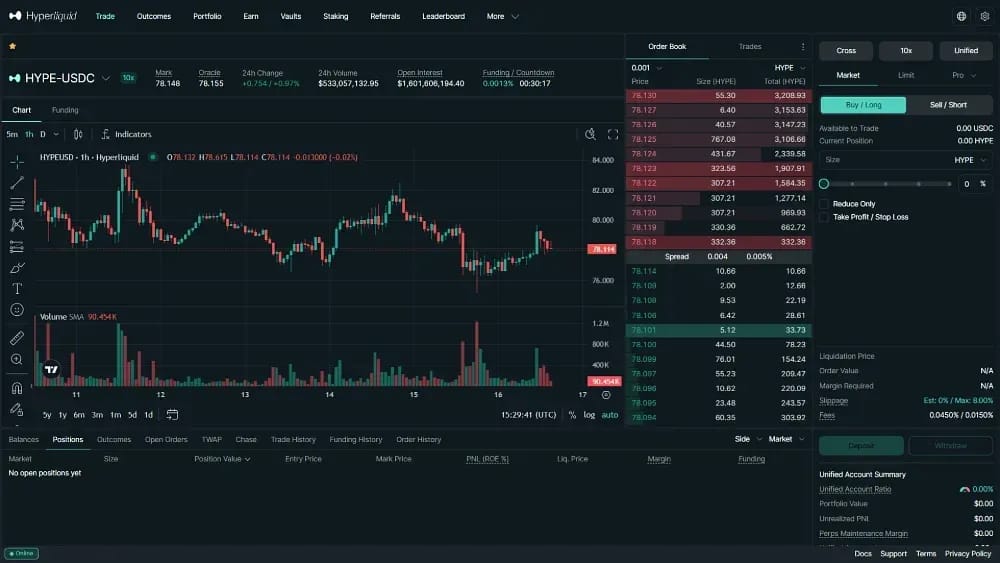
Hyperliquid remains the benchmark for the rest of the sector. Its purpose-built Layer 1 provides sub-second trade finality and currently handles close to 58% of all tracked perp DEX volume. Roughly $200 billion passes through the book every 30 days. Total open interest has recovered to about $14 billion, the highest level since the October 2025 cascade. Full protocol metrics are available in our Hyperliquid statistics dashboard.
Its 2026 advantage increasingly comes from distribution. Coinbase started routing Base App order flow into Hyperliquid liquidity in August 2026. HIP-3 markets now cover crude oil, gold, silver, and the officially licensed S&P 500. On testnet, the HIP-3 Star upgrade gives deployers finer control over markets.
The token economics continue to reinforce that growth. Roughly 97% of protocol fees are directed to the Assistance Fund for automated HYPE buybacks. HYPE reached a fresh all-time high near $88 in early September after Hashdex added it to the Nasdaq-listed NCIQ crypto index ETF. Spot HYPE ETF filings can be tracked through our Hyperliquid ETF tracker.
Pros
- Deepest liquidity and tightest spreads of any perp DEX, with BTC and ETH majors competing with top-tier centralized exchanges.
- HIP-3 supports 24/7 trading in oil, gold, and silver, along with the only officially licensed S&P 500 perpetual anywhere.
- Real fee revenue funds aggressive HYPE buybacks, now reinforced by index ETF inclusion and pending spot filings.
- Coinbase Base App routing and MetaMask Perps integrations convert major consumer apps into Hyperliquid front-ends.
Cons
- HIP-3 markets use deployer-managed oracles and are not protected by the native HLP vault.
- The primary front-end remains restricted for US-based traders, even as regulators discuss possible onshore pathways.
- Foundation-linked validators still control a large portion of staked HYPE, leaving decentralisation questions unresolved.
2. Lighter
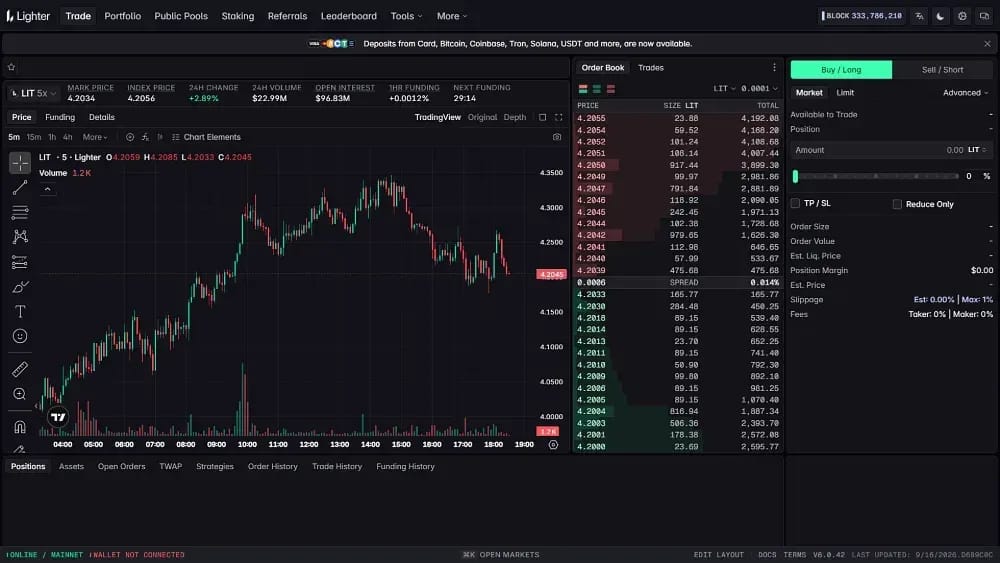
Lighter is a zk-rollup exchange that settles to Ethereum and publishes validity proofs for every match, liquidation, and balance change. Standard accounts pay no maker or taker fees across 219 markets, with leverage of up to 50x. In August, the platform recorded roughly $40 billion in monthly volume while open interest crossed $1 billion for the first time.
Distribution now sits at the center of Lighter's growth. Robinhood Wallet launched native in-app perpetuals on Lighter in July 2026 through the first "Lighter Domain," a dedicated instance with its own sequencing and liquidity. Kraken then listed LIT for spot trading in August, while Partner Attribution allows any third party to build a front-end.
The product range is expanding quickly as well. An extension of Chainlink Data Streams took Lighter beyond 125 oracle feeds across US and Korean equities, forex, and commodities. A July tokenomics overhaul redirected revenue into permanent LIT burns, beginning with 15.5 million tokens. Our Lighter vs Hyperliquid comparison covers how the two exchanges differ.
Pros
- Standard accounts pay zero trading fees, while premium institutional tiers remain far below typical industry maker-taker schedules.
- zk proofs cryptographically verify each trade and liquidation, making execution quality independently auditable on Ethereum.
- Robinhood Wallet integration and Partner Attribution give Lighter mainstream distribution that no other perp DEX currently matches.
- Buyback-and-burn tokenomics are paired with 125+ Chainlink feeds supporting expansion into equity, forex, and commodity perpetuals.
Cons
- Roughly two-thirds of LIT supply starts unlocking from late 2026, creating a substantial overhang for token holders.
- Points incentives still account for a meaningful share of activity, so headline volume overstates durable organic flow.
- Operating as a US C-Corp while offering retail leverage creates more direct regulatory exposure than offshore competitors face.
3. Polymarket Perps
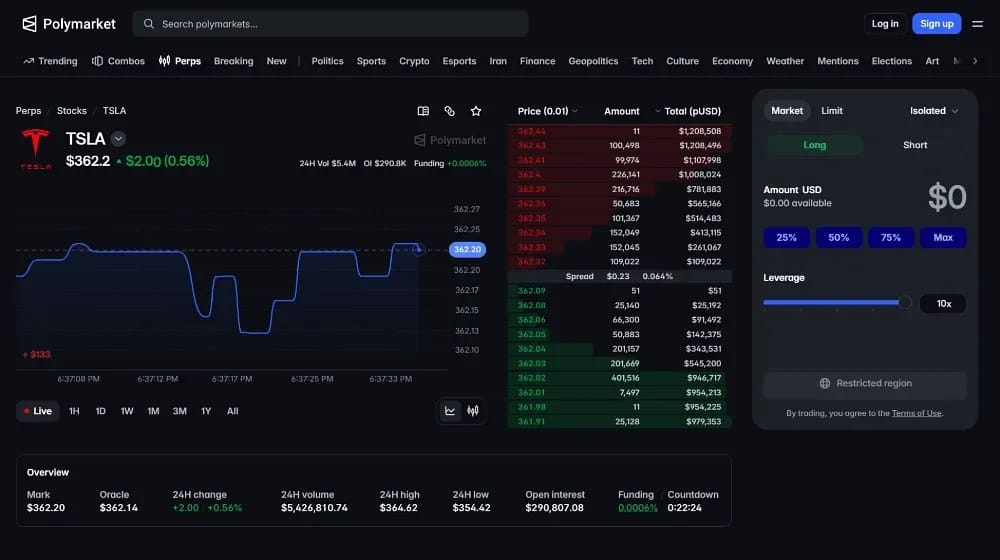
Polymarket Perps launched on September 3, 2026, adding a full perpetuals venue to the world's most-traded prediction market. Within hours, its lineup expanded from 10 to 67 contracts. Markets include BTC, ETH, SOL, HYPE, gold, silver, WTI oil, the S&P 500, the Nasdaq 100, and a SpaceX pre-IPO contract, with every position margined in pUSD.
Its distinguishing feature is the ability to combine trades in ways standalone perp DEXs cannot. From one account, a trader can buy an event contract tied to a Federal Reserve decision and short the S&P 500's reaction at the same time. The beta period attracted $13 billion in cumulative volume before the public launch. For more background on the platform, see what is Polymarket.
Access and disclosure remain important limitations. Perps are available internationally only. US users are directed to the separate CFTC-regulated Polymarket US exchange, which does not offer leverage. At launch, the complete fee schedule, margin thresholds, and liquidation mechanics had not been fully published. Eligibility details are covered in our Polymarket restricted countries guide.
Pros
- Event contracts and leveraged perps can be paired in one account, allowing traders to express views on both outcomes and the resulting market reaction.
- A single pUSD balance covers 67 markets spanning crypto, equities, indices, commodities, and pre-IPO exposure such as SpaceX.
- Polymarket brings a large existing prediction-market audience and $13 billion of proven beta demand.
- Leverage is capped at 20x on majors and 10x on stocks, keeping risk more contained than on degen-focused rivals.
Cons
- The platform launched without complete public documentation for fees, margin requirements, or liquidation mechanics, limiting cost transparency for now.
- US, Canadian, and several sanctioned-region traders cannot access the product, creating a larger exclusion list than most perp DEXs.
- Two weeks of public live trading is not enough history to judge execution during severe market stress.
4. Aster
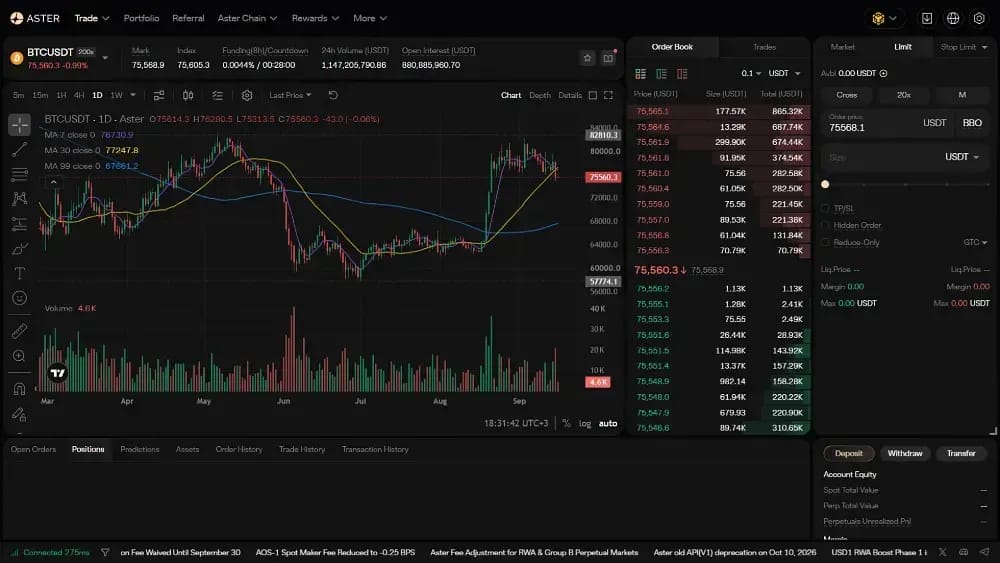
Aster moved onto its own privacy-focused Layer 1 in March 2026. The network combines zero-gas execution with encrypted orders and stealth addresses, making position hunting structurally difficult. Aster regularly ranks among the top three perp DEXs by volume and clears tens of billions monthly across more than 150 markets, although its open interest remains far below Hyperliquid's.
Tokenomics discipline strengthened considerably this year. Aster has roughly 256,000 holders, the largest holder base among recently launched perp DEX tokens. The team also extended the lock on its 400 million ASTER allocation until September 2027. An accelerated buy-and-burn program remains active, even with ASTER trading about 70% below its $2.41 high.
The platform continues to offer the sector's widest feature set. Shield Mode provides private high-leverage trading. Tokenized equity perps for Apple, Tesla, and Nvidia run at 50x, forex goes as high as 200x, and major crypto markets carry a headline maximum of 1001x. Our full Aster DEX review examines the platform in more detail.
Pros
- A privacy Layer 1 provides encrypted order flow and stealth addresses by default, a combination unmatched among high-volume perp exchanges.
- Aster maintains a consistent top-three volume ranking and has the broadest holder base of any newly launched perp DEX token.
- Team tokens remain locked until September 2027, while continued buy-and-burn activity reduces near-term pressure on ASTER supply.
- One cross-margin account covers crypto, tokenized US equities, and forex with leverage reaching 200x.
Cons
- Transparency concerns persist after DefiLlama previously delisted Aster's volume data during its incentive-heavy growth phase.
- ASTER still trades roughly 70% below its all-time high despite significant cumulative buyback spending.
- Retail traders who size positions carelessly face extreme liquidation risk at the advertised 1001x maximum leverage.
5. Jupiter Perps
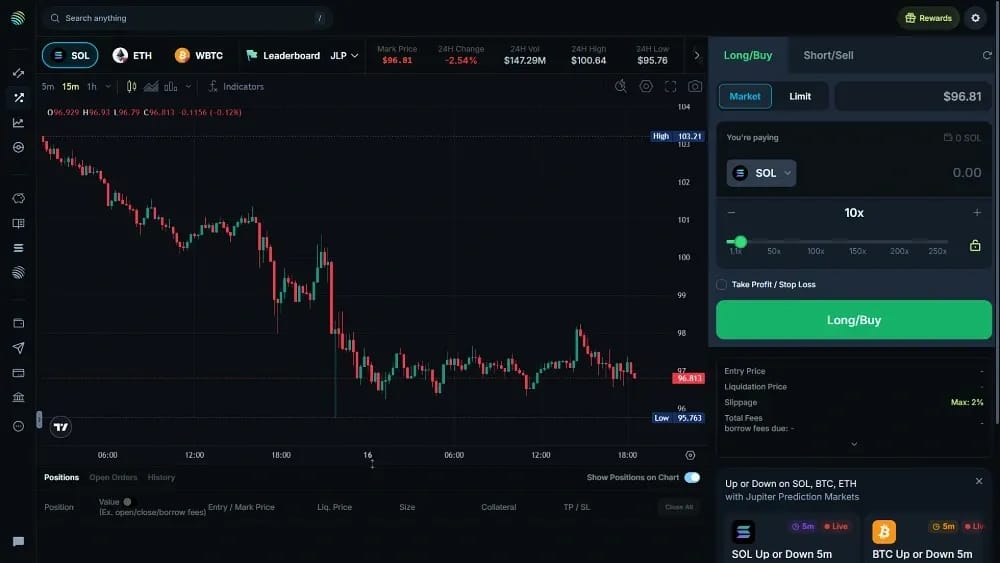
Jupiter Perps is the derivatives arm of Solana's dominant DeFi superapp. Jupiter routes roughly 95% of the network's aggregator volume and holds around $3 billion in TVL. Perp traders can use 100x leverage on SOL, ETH, and wBTC, while selected pairs reach 250x. Trades route against the Jupiter Liquidity Provider (JLP) pool.
Its structure differs from order-book exchanges. Instead of funding rates, positions incur transparent hourly borrow fees. Makers pay nothing and takers pay 0.06%. Any SPL token can also be deposited as collateral through automatic swap routing, keeping the workflow native to Solana users.
Jupiter expanded aggressively across its ecosystem in 2026. JupUSD launched in January with backing that includes BlackRock-affiliated assets through Ethena. In February, Polymarket integration arrived alongside a $35 million ParaFi investment. Jupiter Lend deposits later climbed toward $800 million, while roughly 30% of JUP supply has now been burned.
Pros
- Zero maker fees and hourly borrowing costs replace opaque funding mechanics with a more transparent, predictable pricing model.
- Aggregator auto-routing allows any SPL token to serve as collateral, reducing swap friction for Solana-native portfolios.
- JupUSD, Jupiter Lend, tokenized stocks, and Polymarket are integrated into a single full-stack onchain finance app.
- Roughly 30% of JUP has been burned, with fee-funded buybacks continuing to reduce supply.
Cons
- Only three perp assets are tradable, far fewer than the selections available on Hyperliquid, Aster, or Lighter.
- Because JLP is pool-based, large trades can encounter borrow-rate spikes rather than order-book depth during volatile periods.
- The platform has no commodity, forex, or index perps to match the sector's accelerating expansion into TradFi assets.
6. EdgeX
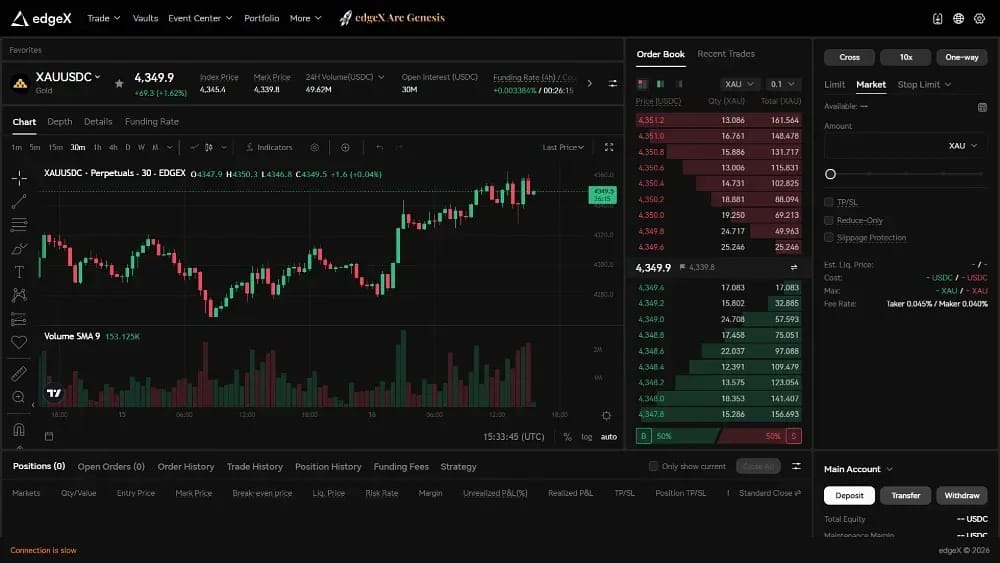
EdgeX was incubated by Amber Group and has finished migrating from StarkEx to EDGE Chain, a purpose-built network based on Arbitrum. Circle Ventures invested in February 2026. The following month, native USDC with CCTP went live on EDGE Chain, making Circle-issued dollars the default asset for margin and settlement.
The V2 migration through July 2026 brought more institutional infrastructure. A vault program developed with risk manager Gauntlet offers annual rewards of up to roughly 7%, divided between USDC yield and EDGE incentives. Matching runs below 10ms across more than 150 markets covering crypto, US stocks, and commodities.
Currencies are the next expansion area. EdgeX launches on Circle's Arc mainnet on September 16, 2026, beginning with Japanese yen FX perpetuals. These markets are margined and settled in native USDC, bringing an asset class to onchain trading that no major perp DEX has yet productised at scale.
Pros
- Direct Circle backing, native USDC, and CCTP give EdgeX the strongest stablecoin alignment among perp DEXs.
- Its Arc mainnet launch makes EdgeX a first mover in onchain FX perpetuals and opens access to a multi-trillion-dollar asset class.
- Gauntlet-designed vaults provide passive depositors with risk-managed yield sourced from real trading flow rather than emissions.
- Matching latency below 10ms and deep BTC liquidity can rival centralized execution for high-frequency strategies.
Cons
- EDGE remains volatile during its first post-TGE year, making incentive-based loyalty programs harder to manage.
- Running EDGE Chain while expanding onto Arc divides engineering attention between two settlement environments.
- A lower open-interest-to-volume ratio than Hyperliquid indicates that more of the flow comes from short-duration trading rather than longer-held positions.
7. dYdX
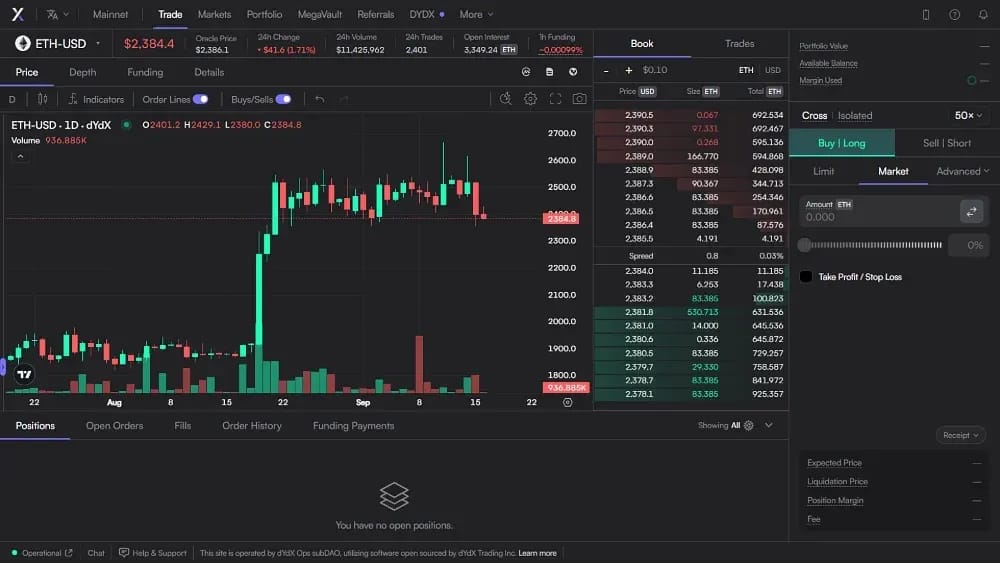
Founded in 2017 by former Coinbase engineer Antonio Juliano, dYdX has maintained a clean nine-year security record while processing more than $1.5 trillion in lifetime volume. Its SOL spot market, launched in December 2025, gave US-based traders access to the platform for the first time. That leaves dYdX positioned ahead of rivals if regulators eventually allow perpetuals onshore.
Its tokenomics have shifted strongly toward holders. Governance approved directing 75% of net protocol revenue to open-market DYDX buybacks. All token unlocks finished in June 2026, removing the emission overhang that had persisted for years. Telegram-based trading from the Pocket Protector acquisition is also being integrated into the product.
The venue still offers one of the deepest professional toolsets available onchain. Traders can access more than 200 perpetual markets, maker rebates as low as -0.011%, advanced order types, and full API support. Its real-world-asset roadmap begins with synthetic Tesla equity.
Pros
- A clean nine-year security record gives dYdX the longest operating history of any decentralized derivatives venue by a wide margin.
- Spot-market availability in the US gives dYdX a regulatory head start over competitors that remain offshore-only.
- All supply unlocks ended in June 2026, and 75% of net revenue now goes toward DYDX buybacks.
- Multiple protocol generations have produced institutional-grade APIs, advanced order types, and maker rebates.
Cons
- Monthly volume is an order of magnitude below Hyperliquid's after flow shifted toward faster exchanges.
- Traders based on EVM and Solana rails face added deposit friction from the Cosmos app-chain architecture.
- Most of the RWA perpetuals roadmap remains unshipped while competing exchanges already offer live TradFi markets.
8. ApeX
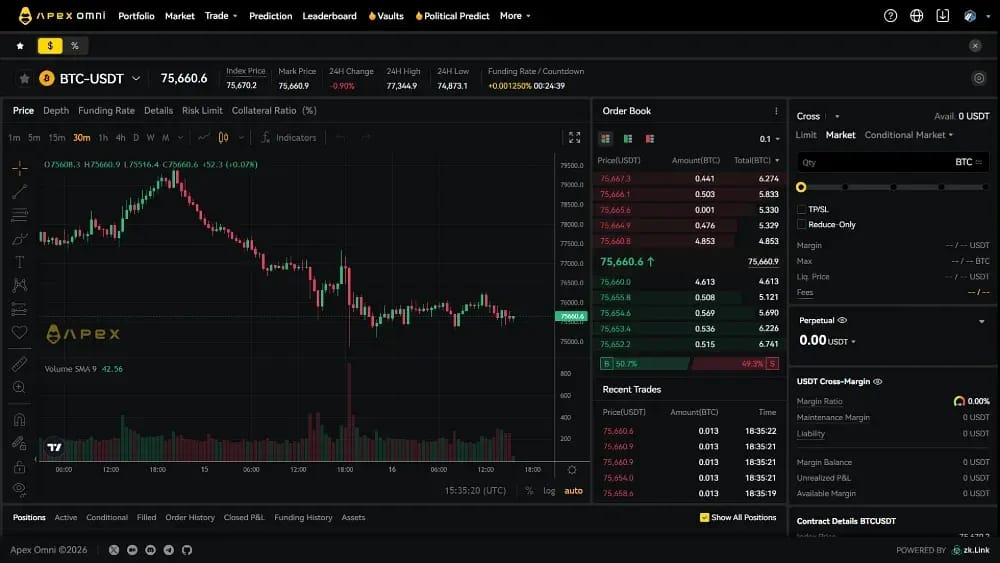
ApeX Protocol operates on a zkLink-powered Layer 2 and offers gas-free trading across six chains, including Ethereum, Arbitrum, Base, and Solana. Cumulative volume has exceeded $200 billion across more than 150 markets. Coverage extends from crypto and tokenized US stocks to leveraged prediction contracts, with first-in-class portfolio margin and multi-collateral support.
Onboarding took priority in 2026. Fiat on-ramps arrived in July with bank-card and digital-wallet support across 40+ currencies. An August AEON Pay partnership then made APEX spendable at more than 50 million merchants, creating an unusual real-world utility loop for a perp DEX token. For traders focused on equities, it pairs naturally with the best tokenized stock trading exchanges.
Yield products and infrastructure complete the offering. Protocol vaults pay depositors up to roughly 7.65% from platform trading fees. Chainlink Data Streams supply low-latency RWA pricing across five chains, while the dedicated Omni AppChain settlement layer remains under active development.
Pros
- More than 150 markets span crypto, tokenized stocks, and prediction contracts, supported by portfolio margin and multi-collateral accounts.
- Fiat on-ramps across 40+ currencies, together with Privy email login, remove much of the usual Web3 onboarding friction.
- AEON Pay lets users spend APEX at 50 million merchants, giving the token genuine payments utility.
- CertiK-monitored infrastructure has had no publicly reported exploits since launch across any Omni deployment.
Cons
- Despite broad product coverage, daily volume and open interest remain a small fraction of sector-leading levels.
- ApeX's buyback program is modest compared with the value-accrual engines used by Hyperliquid, Aster, or Lighter.
- The Omni AppChain remains under development rather than operating today as a differentiated settlement layer.
The 2026 Perp DEX Themes You Need to Know
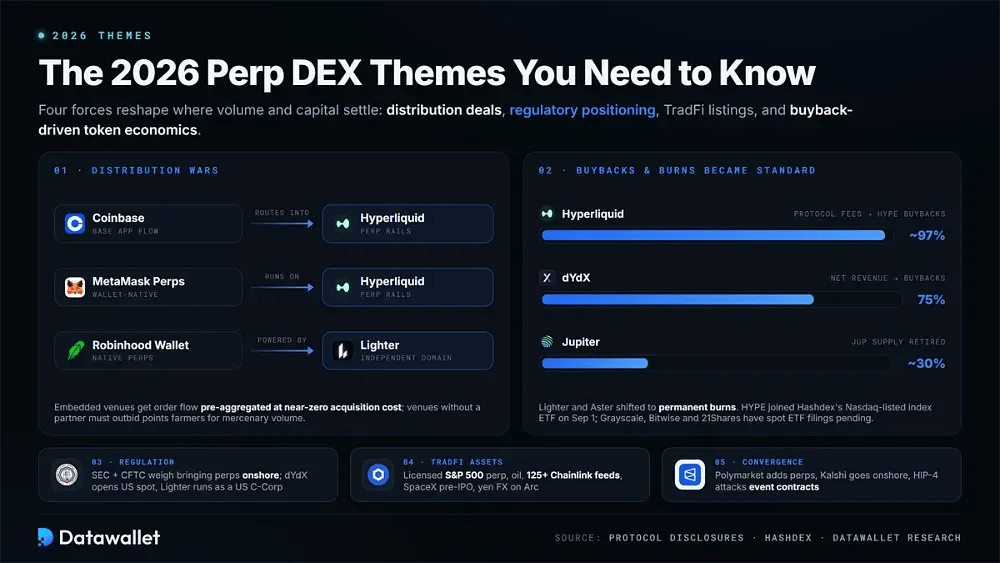
Competition is no longer centered only on building the fastest matching engine. Distribution, regulatory positioning, and sustainable token economics now play a much larger role in determining where volume, open interest, and capital settle. Four forces are reshaping the sector in 2026.
Distribution Wars: Wallets and Brokers Route Into Perp DEXs
One of the most consequential changes in 2026 is that perp DEXs no longer have to acquire every trader one wallet at a time. Instead, they are integrating with applications that already serve millions of users. Coinbase routes Base App flow into Hyperliquid, MetaMask Perps uses Hyperliquid rails, and Robinhood Wallet offers native perpetuals through an independent Lighter Domain.
That shift creates difficult economics for exchanges without distribution partners. When a wallet or broker embeds a perp DEX, the order flow arrives pre-aggregated and user acquisition costs effectively fall to whatever the distributor has already spent. Platforms without those channels have to compete for points farmers and other mercenary volume, precisely the type of activity that disappeared after the 2025 airdrop cycle ended.
Regulators Crack the Door Open for Onchain Perps
The SEC and CFTC signalled in late 2025 that they would consider bringing perpetual contracts onshore, prompting the industry to spend 2026 preparing for that possibility. dYdX introduced US spot access. Polymarket divided its operations between an international perps venue and a CFTC-regulated US exchange, while Lighter operates as a US C-Corp and is betting on greater domestic clarity.
The outcome remains unresolved. Most perp DEX front-ends are still not legally accessible to US traders. The FCA maintains its ban on crypto derivatives for UK retail, while MiCA leaves the treatment of EU front-ends ambiguous. Even so, exchanges building compliant rails today hold a call option on the largest untapped derivatives market on earth.
TradFi Assets Are Now Core Perp DEX Volume
The model that started as an experiment with HIP-3 has become standard sector architecture. Hyperliquid operates the only officially licensed S&P 500 perpetual alongside deep oil markets. Lighter streams more than 125 Chainlink feeds covering US and Korean equities. Polymarket offers SpaceX pre-IPO exposure, while EdgeX is launching yen FX perps on Arc.
Always-on pricing provides the structural advantage. If macro news breaks on a Sunday night, CME and ICE are closed, but onchain S&P 500, crude, and gold contracts keep trading through the gap. From one self-custodied account, traders can now hedge equity exposure, short oil, or go long silver without using a traditional broker.
Buybacks and Burns Became the Sector Standard
Hyperliquid's Assistance Fund directs roughly 97% of protocol fees toward open-market HYPE purchases, pushing serious competitors to introduce comparable value-accrual mechanisms. dYdX now allocates 75% of net revenue to buybacks. Lighter and Aster have both moved toward permanent burns, while Jupiter has retired around 30% of JUP supply.
Institutional interest followed. HYPE joined Hashdex's Nasdaq-listed index ETF from September 1, with spot ETF filings from Grayscale, Bitwise, and 21Shares still pending. That development shows traditional allocators treating perp DEX fee streams as investable cash flows. Revenue and burn rates now play a larger role in how these tokens are priced, rather than pure narrative alone, marking a structural maturation for the category.
Prediction Markets and Perp DEXs Are Converging
The boundary between outcome betting and price trading is breaking down from both sides. Polymarket added leveraged perps to the largest prediction market. Kalshi brought CFTC-regulated perpetuals onshore, while Hyperliquid's HIP-4 outcome markets approach event contracts from the derivatives side.
For traders, this convergence supports more complex strategies within a single account. An election or Fed-decision contract, for example, can be paired with an index perp that hedges the market reaction. Platforms face a different consequence: every venue is competing for the same risk-taking customer. That points toward fee compression, cross-margining between event and perp positions, and more consolidation among smaller single-product exchanges.
Perp DEX vs Perp CEX: Which Is Better for Traders?
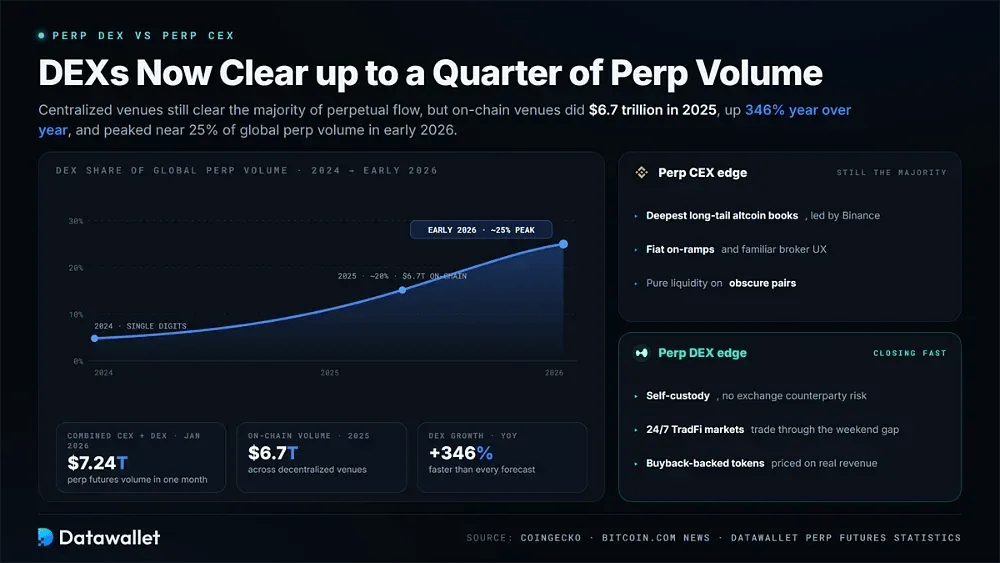
Centralized exchanges still account for most global perpetual volume. Combined CEX and DEX perp futures activity reached $7.24 trillion in January 2026 alone, and Binance remains the single deepest venue for long-tail altcoins and fiat on-ramps. Traders seeking pure liquidity in obscure pairs will still find the best centralized futures exchanges difficult to beat.
Even so, the gap is closing faster than forecasts suggested. Onchain exchanges processed $6.7 trillion across 2025, up 346% year over year and reached roughly a quarter of global perp flow at their early-2026 peak. Hyperliquid's execution quality and expansion into TradFi listings helped drive that growth.
Our perpetual futures statistics page tracks the complete DEX-to-CEX ratio. For self-custody, 24/7 TradFi access, and buyback-backed tokens, perp DEXs are increasingly where serious capital settles.
How to Choose a Perp DEX
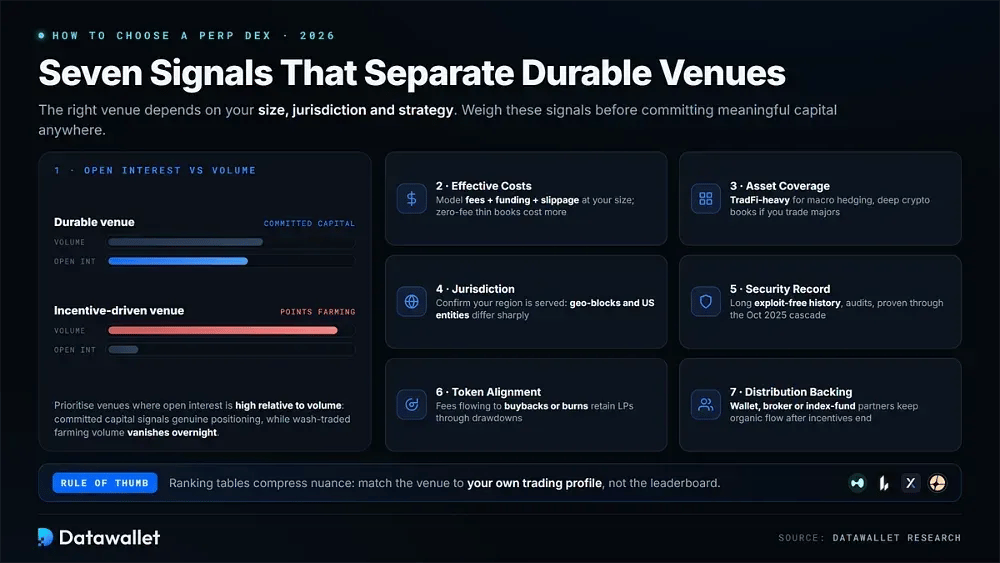
Ranking tables cannot capture every trade-off. Your size, jurisdiction, and strategy determine which venue is appropriate, so weigh the factors below against your own trading profile before committing meaningful capital.
These criteria help distinguish durable exchanges from those driven mainly by incentives:
- Open Interest. Give preference to exchanges where open interest is high relative to volume. Committed capital is a stronger sign of genuine positioning than wash-traded points farming that can disappear overnight.
- Effective Costs. Calculate the true all-in cost at your normal position size, including fees, funding, and slippage. A zero-fee book with shallow depth can still be more expensive.
- Asset Coverage. Choose coverage that matches your strategy. TradFi-heavy exchanges suit macro hedging, while traders focused on major crypto assets may care more about deep crypto books.
- Jurisdiction. Verify that the platform actually serves your region before depositing. Geo-blocks, front-end restrictions, and separate US entities differ considerably across the exchanges on this list.
- Security Record. Favour exchanges with long exploit-free histories, published audits, and demonstrated resilience through stress events such as the October 2025 liquidation cascade.
- Token Alignment. Determine whether protocol fees support buybacks or burns. exchanges with real value accrual tend to retain liquidity providers more effectively during drawdowns.
- Distribution Backing. Wallet, broker, and index-fund partnerships can signal durability because integrated platforms continue receiving organic flow after incentive programs end.
Trading Fees on Perp DEXs
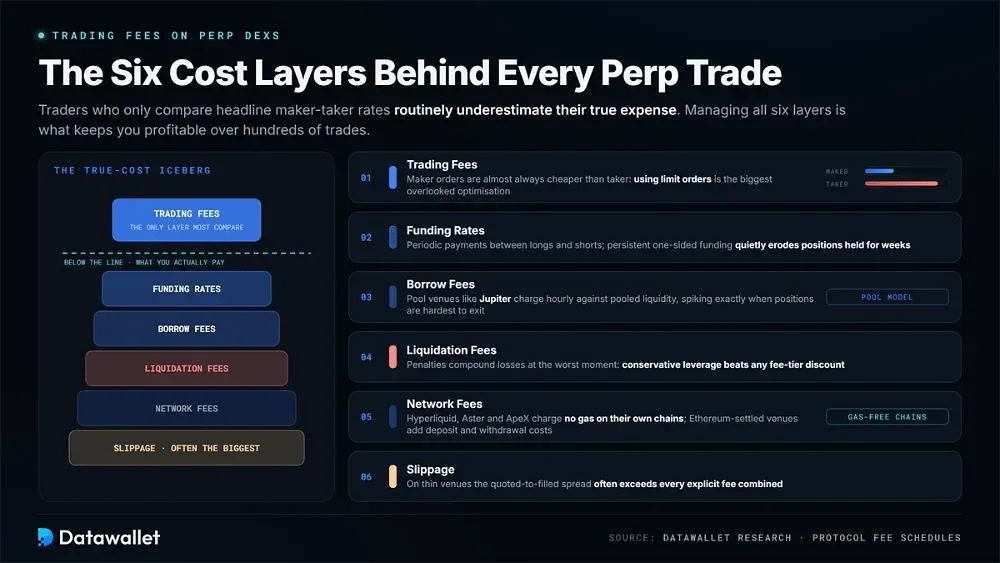
The cost of decentralized perpetual trading comes from several sources. Looking only at headline maker-taker rates routinely understates the true expense, especially across hundreds of trades.
Perp DEX traders should monitor six separate cost layers:
- Trading Fees. Maker orders are almost always cheaper than taker orders. Using limit orders instead of market orders therefore remains one of the largest cost optimisations many traders overlook.
- Funding Rates. Funding rates keep perpetual prices aligned with spot by transferring periodic payments between longs and shorts. Persistent one-sided funding can quietly erode leveraged positions held for weeks.
- Borrow Fees. Pool-based exchanges such as Jupiter replace funding with hourly borrowing charges against pooled liquidity. Those charges can spike during volatility, precisely when positions are most difficult to exit.
- Liquidation Fees. These penalties apply once margin drops below maintenance thresholds and can compound losses at the worst possible time. Conservative leverage is cheaper than any fee-tier discount.
- Network Fees. Hyperliquid, Aster, and ApeX charge no gas on their own chains. Ethereum-settled exchanges, by contrast, add deposit and withdrawal costs that matter more to smaller accounts.
- Slippage. Execution on larger orders depends heavily on order-book depth. On thin exchanges, the difference between quoted and filled prices can exceed every explicit fee combined.
Risks of Using Decentralized Perpetual Exchanges
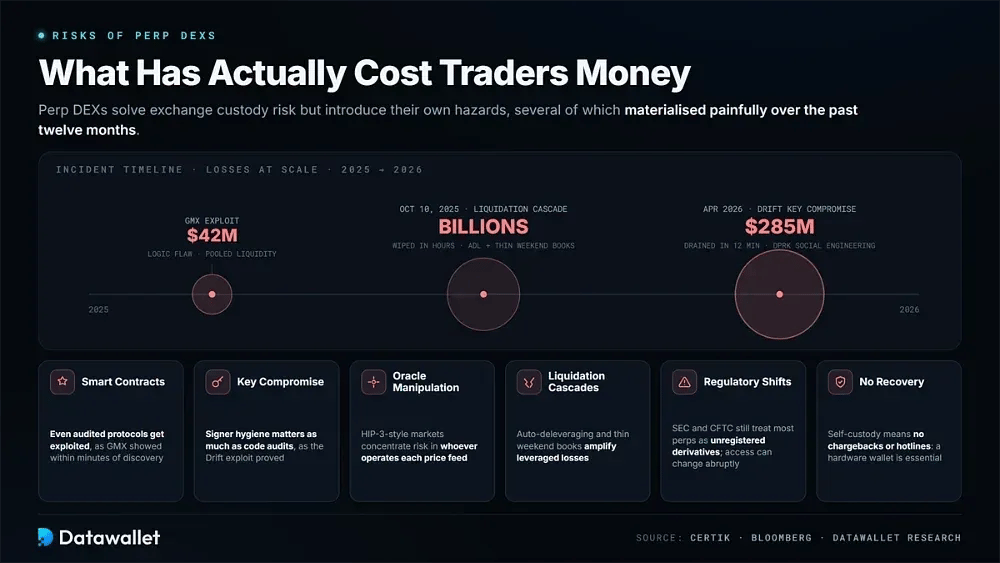
Perp DEXs remove exchange custody risk, but they introduce a different set of hazards. Several of those risks materialised painfully during the past twelve months, making them important to understand before committing meaningful capital onchain.
The following categories have already resulted in real trader losses:
- Smart Contracts. Audits do not eliminate exploit risk. The GMX $42M incident showed how logic flaws in pooled liquidity could drain markets within minutes of discovery.
- Key Compromise. The April 2026 Drift exploit drained $285 million in twelve minutes through DPRK-linked social engineering, demonstrating that signer hygiene matters as much as code audits.
- Oracle Manipulation. Perp exchanges rely entirely on Pyth, Chainlink, or deployer-managed feeds. HIP-3-style markets concentrate that exposure in the operator of each individual price oracle.
- Liquidation Cascades. During the October 10, 2025 crash, billions in leveraged positions were wiped out within hours. The episode demonstrated how auto-deleveraging and thin weekend books can amplify losses.
- Regulatory Uncertainty. The SEC and CFTC still treat most perpetuals as unregistered derivatives. Access rules can therefore change abruptly across entire jurisdictions.
- Recovery Limitations. Self-custody provides no chargebacks, support hotlines, or recourse for compromised keys. A quality hardware wallet is therefore essential rather than optional.
Final Thoughts
During 2026, decentralized perpetual exchanges became boring in the best possible sense. Points farming lost much of its influence, while real revenue and open interest became more important measures of platform quality. The exchanges that survived now provide infrastructure that Coinbase, Robinhood, and index-fund issuers integrate directly instead of trying to compete against.
Hyperliquid has built a substantial, self-reinforcing lead through genuine fee revenue, ETF-grade institutional recognition, and the only licensed S&P 500 perpetual in existence. Lighter, Polymarket, and Aster occupy distinct niches based respectively on provable execution, prediction-market distribution, and privacy. EdgeX, meanwhile, is opening a new asset class through its FX expansion.
Traders entering the market now should favour exchanges with deep committed open interest and sustainable economics. Position sizes should remain conservative regardless of a platform's advertised maximum leverage, and self-custody means responsibility for fund security ultimately remains with the trader.
Our Methodology for Perp DEX Rankings
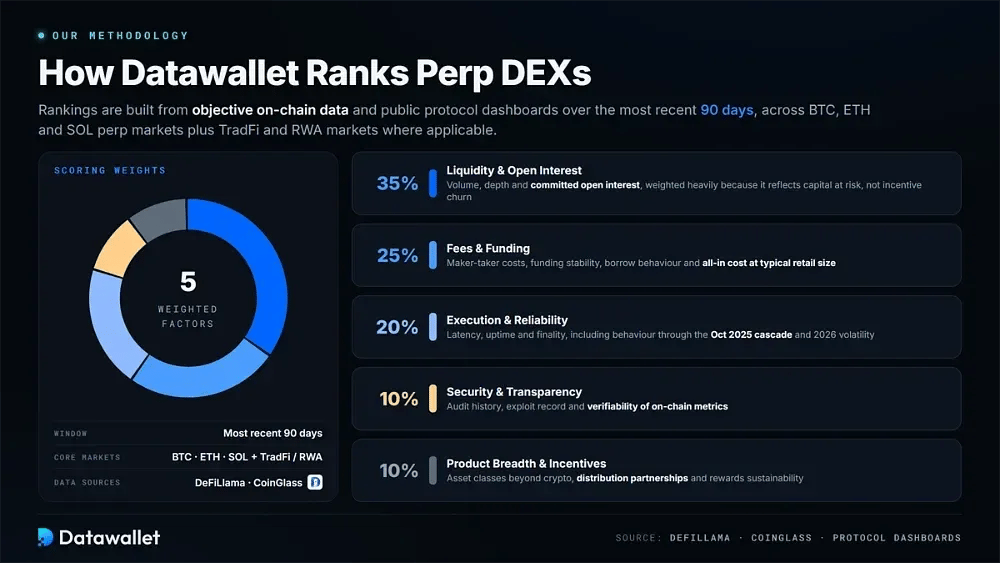
Our rankings use objective onchain data and public protocol dashboards to identify which perp DEXs traders can rely on for deep liquidity, fair execution, and sustainable economics. The evaluation window covers the latest 90 days across BTC, ETH, and SOL perpetual markets, with TradFi and RWA markets included where applicable.
- Liquidity and Open Interest (35%) - We assess 24-hour volume, committed open interest, and order book depth using DeFiLlama, CoinGlass, and protocol dashboards. Open interest carries substantial weight because it measures capital at risk rather than incentive-driven churn.
- Fees and Funding (25%) - This category covers maker and taker charges, funding-rate stability, borrow-fee behaviour, and effective all-in cost at a typical retail position size.
- Execution and Reliability (20%) - We consider latency, uptime, and settlement finality, including venue performance during the October 2025 liquidation cascade and 2026 volatility events.
- Security and Transparency (10%) - Audit history and exploit records are assessed alongside disclosure quality and the verifiability of public onchain metrics.
- Product Breadth and Incentives (10%) - We evaluate the number and type of markets offered, asset classes beyond crypto, distribution partnerships, and whether rewards programs appear sustainable.